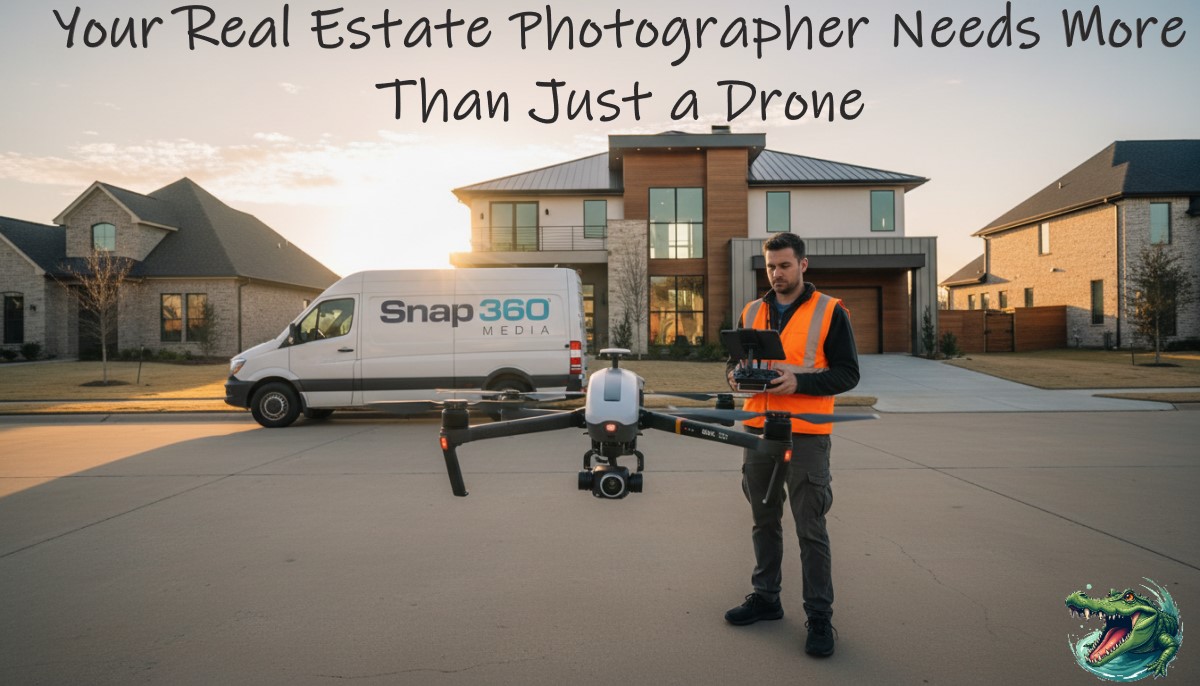
Why Your Real Estate Photographer Needs More Than Just a Drone
Why Your Real Estate Photographer Needs More Than Just a Drone: A Guide to Legal & Safe Aerial Media
Everyone has a cousin with a drone, but in the world of professional real estate, "winging it" is a massive legal risk. Whether we are shooting a luxury listing in Lake Charles or a 50-acre ranch in Livingston, Texas, aerial media is about more than just a pretty picture—it’s about federal compliance, privacy laws, and safety.
At Snap 360 Media, we don't just fly; we operate. Here is what goes on behind the scenes to protect our clients and their listings.
1. The Part 107 Barrier: It’s Not a Hobby
If a drone is used to help sell a house, it is a commercial flight. Period. The FAA requires every commercial pilot to hold a Part 107 Remote Pilot Certificate.[1]
Why it matters to you: If you hire an unlicensed "hobbyist" and something goes wrong (like a crash or a privacy complaint), the liability can fall back on the agent or the homeowner. We carry our license on every job to ensure your listing is 100% legal.[2]
2. Navigating the "Invisible Walls" of Airspace
Lake Charles is a complex place to fly. Between Lake Charles Regional (LCH) and Chennault (CWF), much of our local sky is "Controlled Airspace."
The "Zero Grid" Reality: Some properties are in areas where drones are technically grounded by default. We use the LAANC system to get digital "permission slips" from the FAA in real-time.[3] If a property is in a high-security flight path, we handle the manual paperwork so you don't have to worry about a federal fine landing on your doorstep.
3. Respecting the "Expectation of Privacy"
Louisiana and Texas have strict privacy and "surveillance" laws. You can’t just hover over a neighbor's pool to get a shot of your client's backyard.[4][5]
Our "Permission to Fly" Form: We use a formal authorization process for every shoot. This isn't just paperwork; it’s a legal "affirmative defense" that proves we have the homeowner's consent to record. It protects the agent from "Peeping Tom" or "Trespass" allegations.
4. More Than Just Height: The Art of the Angle
A common mistake is flying too high. At 400 feet, a house looks like a toy. We focus on the "Sweet Spot" (20–150 feet).
- Architecture First: We fly low enough to show the front door, the roof quality, and the landscaping—the things that actually sell the home.
- Context is Key: We use height only when it's time to show how close the property is to the water, the park, or the highway.
5. Safety First, Every Time
Manned aircraft—like Med-Flight helicopters or military jets—always have the right of way. If we hear a plane inbound to LCH, we land immediately. We also monitor local ATC frequencies to know who is in the sky before they even appear on the horizon.[1]
Conclusion
When you book Snap 360 Media, you aren't just getting high-res photos. You're getting the peace of mind that comes with a licensed, insured, and law-abiding professional. Industry data shows that 73% of homeowners are more likely to list with an agent who uses aerial drone photography.[6] Don't let your listing be the one that takes a legal nose-dive.
Data Sources & References
- [1] FAA (2024). Part 107 Small UAS Rules
- [2] FAA (2024). Low Altitude Authorization and Notification Capability (LAANC)
- [3] Louisiana State Legislature (2024). RS 14:337 Unlawful use of an unmanned aircraft system
- [4] Texas State Legislature (2024). Government Code Chapter 423: Use of Unmanned Aircraft
- [5] National Association of Realtors (2024). Real Estate in a Digital Age Report