California's New Photo Disclosure Law: What Real Estate Photographers Must Know in 2026
California's Real Estate Photo Disclosure Law: A Guide for Brokers and Agents (2026)
The landscape of real estate marketing changed dramatically on January 1st, 2026. For brokers and agents, what was once a routine marketing decision—enhancing a sky, removing a temporary object, or adding virtual furnishings—now carries significant legal and professional implications. California's implementation of Business and Professional Code Section 10140.8, originally known as Assembly Bill 723, has established a regulatory framework that affects every real estate professional in the state.
This isn't just about following MLS guidelines anymore. The stakes have escalated to potential misdemeanor charges and fines reaching $1,000 for non-compliance. Understanding this legislation and how industry leaders are responding has become essential for anyone managing real estate risk and reputation.
The Catalyst: Why This Law Exists
The explosion of artificial intelligence in image editing created what many describe as the "wild west" of real estate marketing. Sellers and agents could transform properties beyond recognition, creating unrealistic expectations that left buyers disappointed and sometimes misled. What started as helpful enhancement crossed into territory that raised serious consumer protection concerns.
California lawmakers responded by enacting legislation designed to restore transparency and accountability to property marketing. The law targets a specific problem: ensuring that prospective buyers understand when they're viewing an enhanced representation rather than an accurate depiction of a property's current condition.
Decoding Section 10140.8: What Constitutes Digital Alteration
The heart of the controversy lies in how the law defines a digitally altered image. According to the statute, it encompasses any image modified through photo editing software or artificial intelligence to add, remove, or modify elements. The law specifically mentions fixtures, furniture, appliances, flooring, walls, paint colors, hardscape, landscape, building facades, and floor plans.
Critically, it extends beyond the property boundaries to include elements outside of or visible from the property. This encompasses street lights, utility poles, window views, and neighboring properties.
What Remains Permissible
It's essential to understand what the law explicitly exempts. Standard adjustments that don't fundamentally alter the property's representation remain completely acceptable. This includes lighting corrections, sharpening, white balance adjustments, color correction, perspective correction, straightening, cropping, and exposure modifications.
These foundational editing techniques—the bread and butter of professional property photography—can continue without disclosure requirements. The law recognizes that making an image look its best through technical adjustments differs fundamentally from changing what the property actually contains or displays.
The Legal Controversy: Understanding "But Not Limited To"
Two specific phrases in Section 10140.8 have sparked intense debate within the real estate community, particularly around sky replacements.
Terms of Enlargement
The phrase "but not limited to" functions as what legal professionals call a Term of Enlargement. This language signals that the listed items serve as examples rather than a comprehensive catalog. Lawmakers deliberately chose expansive language to prevent creative workarounds that technically avoid listed items while violating the law's spirit.
The Ejusdem Generis Principle
Compounding this broad interpretation is the legal doctrine known as Ejusdem Generis, Latin for "of the same kind." This principle holds that when a law provides specific examples followed by a general category, unlisted items similar to the examples fall under the same rules.
When applied to the phrase "elements outside of or visible from the property," the sky unquestionably qualifies. Some initially argued that because "sky" or "sky replacement" never appears explicitly in the statute, such edits remained permissible. However, legal experts widely dismiss this interpretation. The sky is visible from the property, making it subject to disclosure requirements under any reasonable reading of the law.
Industry Response: The Safe Harbor Strategy
To understand how this law functions in practice, it's valuable to examine how major brokerages have responded. Legal departments at firms including Berkshire Hathaway, Sotheby's International Realty, RE/MAX, and other major players have largely adopted what's known as a Safe Harbor Approach.
This legal strategy operates on a simple principle: when interpretation remains uncertain, err on the side of caution. Rather than testing the boundaries of what might require disclosure, these firms instruct their agents and marketing teams to disclose whenever doubt exists.
Shifting Legal Responsibility
The safe harbor approach serves an important function for brokerages and industry associations. By providing broad guidance that favors disclosure, these organizations protect themselves from liability. The responsibility shifts to individual agents to determine whether specific images require labeling.
Some firms have gone further, indicating that even edits that might technically fall outside the law's scope should be disclosed as a protective measure. This creates a conservative interpretation that minimizes legal exposure but potentially impacts marketing effectiveness.
Multiple Listing Services Join the Movement
California's various Multiple Listing Services have independently developed their own policies in response to Section 10140.8. Most have embraced the safe harbor philosophy, advising members to disclose when uncertain.
The California Regional Multiple Listing Service (CRMLS), one of the state's largest, explicitly endorses disclosure in ambiguous situations. San Diego's Multiple Listing Service (SDMLS) has gone further, specifically including language about "backgrounds of images" in their guidelines—language that clearly encompasses skies and requires disclosure for sky replacements.
Practical Applications: Common Edits Under Scrutiny
Sky Replacements
The most discussed edit in marketing circles, sky swaps now unambiguously require disclosure. Whether transforming an overcast day into brilliant sunshine or adding a dramatic sunset, replacing the sky changes an element visible from the property. Agents must ensure these images carry proper labeling.
Virtual Staging
Virtual staging presents particular challenges. Many AI-powered tools don't simply add furniture to empty rooms—they reconstruct entire spaces, potentially altering walls, floors, and architectural features. These extensive modifications clearly fall under the disclosure requirement.
Faux Twilight Photography
Creating artificial twilight images through compositing or heavy editing changes how the property appears at a specific time of day. These dramatic transformations require disclosure, though they remain permissible when properly labeled with access to daytime originals.
Object Removal
Even seemingly minor removals trigger disclosure requirements. Eliminating a storage pod from a driveway, removing cars from the street, or erasing temporary construction equipment all constitute changing elements in or visible from the property.
Disclosure Requirements: Meeting Legal Standards
The law requires "reasonably conspicuous notice" that images have been digitally altered. In practice, this can take several forms depending on where images appear.
Online Listings
For websites and digital platforms, side-by-side comparisons work effectively. Altered images must be clearly labeled as digitally modified, with unaltered originals readily accessible. Users should be able to easily navigate between versions to compare them.
Print Materials and Social Media
Physical marketing materials like flyers, brochures, and magazine advertisements require different approaches. QR codes or URLs can direct viewers to original images, but the printed material must clearly explain what the QR code provides. Simply including a code without context doesn't satisfy the "reasonably conspicuous" standard.
Social media posts should include both the disclosure and a clear path to originals, whether through profile links, story highlights, or linked websites.
Impact on Marketing Effectiveness
The disclosure requirement creates a genuine dilemma for real estate marketing. In an era where consumers have grown increasingly skeptical of manipulated imagery, prominently labeling photos as "digitally altered" can trigger immediate distrust.
Potential buyers may question what else might be hidden or misrepresented. The psychological impact of seeing that label can undermine the marketing advantage the enhancements were meant to create.
The Consumer Protection Perspective
From another viewpoint, these disclosures serve their intended purpose. Buyers who make decisions based on heavily altered images often experience disappointment during property viewings. The gap between edited perfection and physical reality can damage trust and derail sales.
By ensuring expectations align with reality from the beginning, the law potentially improves the buying experience and reduces wasted time for all parties. The California Association of Realtors, despite pushing back on earlier, stricter versions of the legislation, has acknowledged that truth in advertising benefits the industry long-term.
Beyond Sales: The Presentation Exception
An important nuance exists within the law that many often overlook. The disclosure requirements apply specifically to marketing materials advertising a property's current condition for sale or lease.
This means agents can still create aspirational imagery for presentations showing a property's potential. Similar to home improvement shows that demonstrate what renovations could achieve, these presentations don't advertise the current state—they illustrate possibilities.
This exception preserves the ability to help buyers visualize how they might transform a space while maintaining honesty about its present condition.
Managing Broker Liability and Marketing Risk
For brokers and agents, this legislation shifts the primary burden of disclosure directly onto the party responsible for the advertisement. While your photographer creates the media, the legal responsibility for the listing's accuracy rests with you.
Reviewing Your Service Agreements
As professional photographers update their terms to comply with AB 723, agents should be proactive in reviewing their service agreements. A clear understanding of roles prevents costly misunderstandings. When working with a media partner, ensure your workflow includes:
- Explicit Direction on Alterations: Clearly communicate when you require sky replacements or virtual staging so the "digitally altered" workflow can be triggered immediately.
- Verification of Assets: Before a listing goes live, verify that you have received both the enhanced images and the original "clean" versions for your brokerage archives.
- Assignment of Responsibility: Understand that while a photographer may provide the labels, the final check for "reasonably conspicuous notice" must be performed by the listing agent or broker-of-record.
Documenting these decisions doesn't just fulfill a legal requirement; it creates a defensive paper trail for the brokerage in the event of an audit or a consumer complaint.
Efficiency in Modern Compliance
Managing disclosure requirements doesn't have to be a bottleneck in your listing timeline. Forward-thinking agents are leveraging these requirements to streamline their marketing by partnering with photographers who handle the technical details of compliance—such as maintaining dual image sets and generating the necessary QR codes for print materials.
By integrating these steps into your standard marketing package, you ensure that every listing is "audit-proof" from day one, allowing you to focus on the sale rather than the paperwork.
Multi-State Implications
While Section 10140.8 currently applies only in California, other jurisdictions are paying close attention. The law could establish precedent that influences MLS policies and legislation in other states and even internationally.
Agents operating in multiple markets should stay informed about how their local MLSs and state legislatures respond to California's approach. The trend toward greater transparency in property marketing appears likely to expand rather than remain isolated.
The Path Forward: Positioning for Success
The implementation of strict disclosure requirements marks the end of an era when digital enhancement could be applied freely without accountability. For some, this represents an unwelcome constraint on creative and marketing freedom. For others, it's a necessary correction that protects consumers and restores integrity to real estate marketing.
Anchoring Your Brand in Transparency
Agents who thrive in this new environment will be those who use transparency as a brand differentiator. By explaining the legal requirements of AB 723 to your sellers, you demonstrate a level of professional expertise that sets you apart from agents who might cut corners.
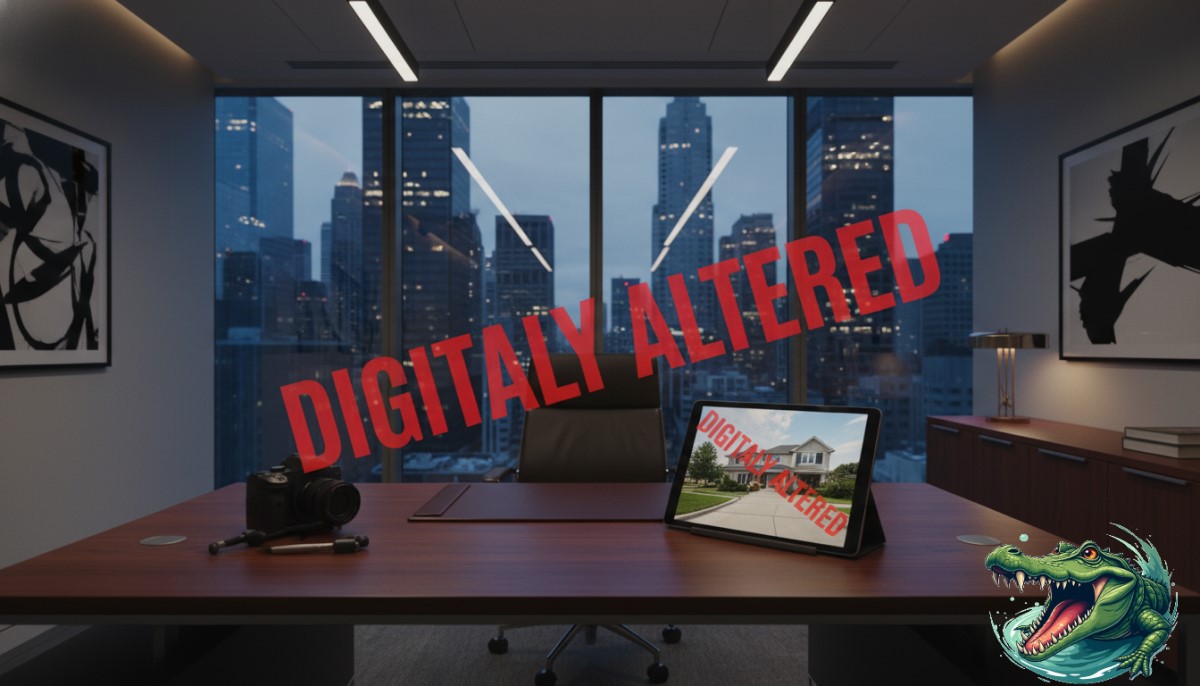
When a potential buyer sees a "Digitally Altered" label on your listing, it shouldn't be viewed as a warning—it should be viewed as a sign of an honest agent who provides accurate data. You aren't just selling a house; you're providing a reliable experience that builds long-term client loyalty.
Ethical Media Creation as Competitive Advantage
Transparency and ethical practices are increasingly important to consumers across all industries. Real estate professionals who visibly commit to honest representation can turn compliance into a marketing advantage.
Rather than viewing disclosure labels as embarrassments, they can be framed as demonstrations of integrity. "All our images are professionally photographed and honestly represented" becomes a selling point that builds trust with potential buyers.
Conclusion: Adapting to the New Regulatory Landscape
California's implementation of disclosure requirements for digitally altered real estate images represents a significant shift in how properties can be marketed. The days of unlimited enhancement without consequence have definitively ended.
Understanding the legal framework, recognizing how major industry players are responding, implementing protective business practices, and positioning compliance as a professional service will separate successful agents from those who struggle in this new environment.
When you protect your listings from legal liability while marketing properties effectively within the law's boundaries, you're not just moving inventory—you're building a sustainable, high-integrity professional practice.
...
Legal Disclaimer
**Important Notice**: Snap360Media is a professional photography and media services company, not a law firm. The information presented in this article is provided for educational and informational purposes only and does not constitute legal advice.
The content herein represents our understanding of current regulations and industry practices based on publicly available information and should not be relied upon as a substitute for professional legal counsel. Laws, regulations, and their interpretations are subject to change, and specific applications may vary based on individual circumstances, jurisdictions, and business structures.
We strongly recommend that all real estate professionals, photographers, brokers, and agents consult with qualified legal professionals licensed in their respective jurisdictions to obtain advice tailored to their specific situations. Only a licensed attorney can provide guidance on how these laws apply to your particular business practices and what compliance measures are appropriate for your operations.
By reading this article, you acknowledge that no attorney-client relationship is created between you and Snap360Media, and you agree that any actions you take based on this information are done at your own discretion and risk.
Data Sources & References
- California State Legislature (2025). AB-723 Real estate: advertisements: digitally altered images.
- California Business and Professional Code. Section 10140.8 - Disclosure of Digitally Altered Photos.
- Nathan Cool Photo (2025-2026). AI Photos BANNED - New Real Estate Law Requires Disclosures for 2026
- Nathan Cool Photo (2026). Are Sky Swaps Still Legal? New 2026 law for Real Estate Photos